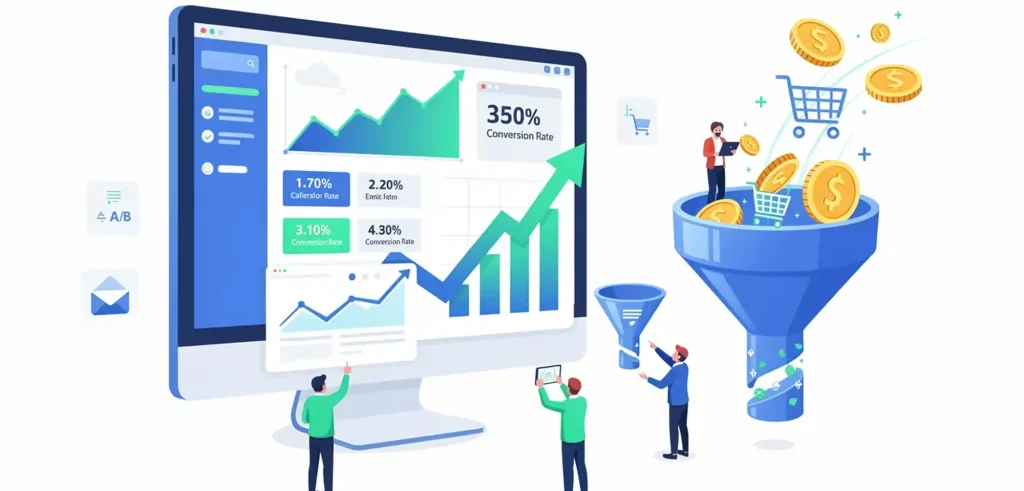
Many business websites appear professional and polished, yet they underperform when it comes to converting visitors into customers or leads. A design that looks “fine” on the surface can often hide deeper issues that prevent conversions. Most conversion problems are strategic rather than purely visual or technical. These underlying issues might include unclear messaging, confusing navigation, or a lack of alignment between the website’s content and the needs of its target audience.
A website conversion occurs when a visitor completes a desired action on your site, such as making a purchase, filling out a form, or signing up for a newsletter.
Even if a site looks modern and visually appealing, it can still fail to engage visitors effectively or guide them toward taking meaningful actions. This disconnect often results in high traffic but low conversion rates, meaning that while many users visit the site, few complete desired actions such as making a purchase, signing up for a newsletter, or requesting more information. A good conversion rate varies by industry, but generally falls between 2% and 5%; understanding these benchmarks helps set realistic goals and highlights the need for ongoing optimization.
Understanding that conversion challenges are often rooted in strategy rather than aesthetics is key to diagnosing and fixing why a website isn’t delivering the results it should. Addressing these strategic factors—like refining your value proposition, simplifying user journeys, and emphasizing clear calls to action—can significantly improve how well your website converts visitors into valuable leads or customers, making website conversions essential for generating leads as well as driving sales.
What “Not Converting” Actually Means
A website conversion occurs when a visitor completes a desired action on your site, such as making a purchase, filling out a form, or signing up for a newsletter.
Conversions are more than just sales. They include a variety of valuable actions, such as:
Filling out contact forms
Making phone calls
Requesting product demos
Signing up for newsletters or email lists
Downloading resources
Engaging with interactive tools on the site
Sometimes, websites attract high volumes of traffic but receive few meaningful inquiries, or the leads generated might be unqualified, inconsistent, or lack engagement. Visitors might spend time browsing pages and interacting with content but ultimately take no clear action, signaling underlying conversion issues.
These behaviors suggest that while users are interested enough to explore, something is preventing them from progressing toward your business goals. Understanding this broader definition of conversions helps businesses identify gaps in their website’s ability to guide visitors effectively through the customer journey.
Addressing these gaps by improving user experience, clarifying calls to action, and aligning content with visitor intent can transform passive browsing into active engagement and ultimately increase the number of valuable conversions your website generates.
It Looks Good—but Isn’t Doing Its Job
A website’s primary purpose is to provide clarity, instill confidence, and guide visitors toward desired actions. Visual polish alone does not guarantee effectiveness. In fact, design can sometimes mask messaging and structural problems. A website should support business goals and conversion paths, not just look modern.
To truly convert visitors into customers or leads, a website must communicate its value proposition clearly and immediately. From the moment users land on the site, they should understand what the business offers and why it matters to them.
Confusing layouts, vague language, or cluttered pages can frustrate visitors and cause them to leave before taking any action. Moreover, a well-designed website builds trust by showcasing credibility through testimonials, case studies, and real examples of work.
Incorporating videos, such as customer testimonials or product demonstrations, can further build credibility and engage visitors by providing dynamic, authentic insights into your offerings.
A user-friendly website anticipates user needs by providing intuitive navigation and clear calls to action that guide visitors smoothly through their journey. Simply having an attractive site is not enough; the design must be user friendly and strategically aligned with the behaviors and expectations of your target audience.
Ultimately, the goal is to create a seamless experience where every element of the website—from visuals and copy to structure and functionality—works together to increase conversions. This requires thoughtful planning, ongoing analysis of user behavior, and continuous optimization to ensure the site not only attracts visitors but also effectively persuades them to engage and convert.
The Most Common Reasons “Good” Websites Fail to Convert
The Message Isn’t Clear Enough (or Comes Too Late)
When visitors cannot immediately understand your value proposition, they tend to leave. If key messages are buried too far down the page, visitors have to put in extra effort to figure out what your business offers.
Often, the language used reflects internal company perspectives rather than addressing the needs of customers. This disconnect can create confusion and frustration, causing potential customers to abandon the site before they engage with any content or calls to action.
To prevent this, it’s crucial to:
Present your value proposition clearly and prominently, ideally “above the fold,” so visitors see it without scrolling.
Use simple, customer-focused language that highlights the benefits and solutions your business provides rather than industry jargon or internal terms.
Ensure supporting elements such as headlines, subheadings, and visuals reinforce the core message and guide visitors toward the next steps.
Maintain consistency in messaging across all pages to build trust and reduce cognitive load.
Regularly reviewing and testing your key messages can ensure they resonate with your target audience and adapt to changing customer needs.

The Site Is Designed for the Business—Not the Buyer
Many websites structure navigation and pages around internal services or departments rather than focusing on solving user problems. This results in unclear or fragmented user journeys, leaving visitors without clear guidance to make decisions.
When a website prioritizes the business’s internal organization over the needs and expectations of its users, it can create confusion and frustration. Visitors often arrive with specific goals or questions, and if the site’s structure doesn’t align with these, they may struggle to find relevant information quickly.
This misalignment can lead to:
Increased bounce rates
Lower conversion rates
Users abandoning the site in search of clearer, more intuitive alternatives
A user-centric approach to website design involves:
Organizing content and navigation based on how visitors think and what they need, rather than how the business is internally arranged
Creating clear pathways that address common user problems
Guiding visitors step-by-step toward valuable actions such as making a purchase, signing up for a newsletter, or requesting a consultation
Optimizing each web page to ensure clear pathways and prominent conversion points
Effective user journeys reduce friction by anticipating questions and providing easy access to answers, thereby increasing engagement and conversions.
Moreover, fragmented navigation can dilute the impact of key messages and calls to action. When users are unsure where to go next or overwhelmed by too many options, they may fail to take any action at all.
To address this, focus on:
Simplifying navigation
Grouping related content logically
Highlighting primary conversion points
Incorporating behavioral analytics and conversion tracking can reveal where users drop off or get stuck, enabling ongoing optimization of navigation and page structure to better meet user needs.
In summary, designing websites with the user’s perspective in mind—prioritizing clarity, simplicity, and problem-solving—creates a more cohesive experience that supports business goals. By shifting from an internally focused structure to a user-focused one, businesses can provide clear guidance, reduce confusion, and ultimately improve website conversions.
There’s No Clear Next Step
An overload of competing calls to action (CTAs) can leave visitors uncertain. Without a clear primary CTA or a defined progression, visitors may hesitate to act.
Common issues include:
Requesting commitment too soon
Relying on generic contact pages as catch-alls
Presenting too many options at once
These practices diminish the potential for conversions by making it unclear what action visitors should take next.
Trust Signals Are Missing or Weak
Trust is crucial for driving conversions. If your site lacks credibility, visitors are less likely to take action.
Common trust issues include:
Using generic or outdated testimonials
Lacking accessible case studies
Missing real examples of work
Relying too heavily on stock photography
Strengthening trust signals by showcasing authentic testimonials, up-to-date case studies, and real examples of your work can significantly improve your site’s credibility and conversion rates.
The Site Isn’t Aligned With How People Actually Find You
If your content does not align with search intent, visitors may arrive at low-value or dead-end pages. Ads, such as Google or social media ads, are another way visitors find your site, and tracking the effectiveness of ad spend is crucial for optimizing conversions.
Blog posts that fail to support conversion pathways leave visitors without clear direction to make decisions. This misalignment can lead to:
Increased bounce rates
Missed opportunities to engage potential customers effectively
When users land on pages that do not meet their expectations or answer their queries, they are less likely to stay and explore further, reducing the chances of conversion.
To prevent this, it is essential to:
Conduct thorough keyword research
Understand the intent behind the search queries that bring visitors to your site
Tailor your content to address these intents—whether informational, navigational, transactional, or commercial
Integrate clear calls to action within your blog posts and other content
By aligning content with search intent, you not only improve user experience but also enhance your website’s effectiveness in generating conversions and achieving business goals.
The Role of SEO in Conversion
Search Engine Optimization (SEO) is more than just a way to boost your website’s visibility—it’s a powerful tool for increasing your website conversion rate. By targeting the right keywords and optimizing your site for your specific audience, you attract visitors who are already interested in what you offer. This targeted traffic is far more likely to convert, helping you achieve an average website conversion rate that meets or exceeds industry benchmarks.
To maximize your website’s conversion rate through SEO, focus on creating engaging content that directly addresses the pain points and needs of your target audience. Each page should be designed to answer the questions your visitors are searching for, guiding them naturally toward taking action. Use keywords thoughtfully, but always prioritize user experience and readability over keyword stuffing.
Technical SEO also plays a role in conversion. A fast-loading, easy-to-navigate website keeps visitors engaged and reduces bounce rates, while mobile-friendly design ensures that users on any device can interact with your site seamlessly.
By aligning your SEO strategy with the needs of your audience and the goals of your business, you not only increase traffic but also improve the likelihood that those visitors will convert—turning your website into a true driver of business growth.

Mobile Responsiveness and Conversion
With more users browsing and shopping on mobile devices than ever before, mobile responsiveness is essential for achieving a high conversion rate. A mobile-responsive website automatically adapts to different screen sizes, ensuring that your content, images, and forms look great and function smoothly on any device.
This seamless user experience encourages visitors to:
Stay longer
Engage with your content
Complete desired actions—whether that’s filling out contact forms, signing up, or making a purchase
To increase conversions, use a website builder that offers mobile-friendly templates and regularly test your site on various devices to catch any issues with layout or functionality. Pay special attention to key pages like landing pages and contact forms, as these are often where conversions happen.
Optimizing these pages for mobile devices—by simplifying forms, using larger buttons, and ensuring fast load times—can significantly reduce bounce rates and help you capture more leads and sales.
Remember, a mobile-responsive site isn’t just a nice-to-have; it’s a necessity for reaching your audience wherever they are and providing the user experience that today’s visitors expect.
Why “Conversion Fixes” Often Don’t Work
While tools like A/B testing, heatmaps, and session recordings provide useful data, they can’t resolve core problems such as weak positioning or unclear messaging. Without a strong strategic foundation, optimization efforts typically yield only minor improvements.
These tools are excellent for identifying surface-level issues like button placement or color schemes. Analyzing these tools can provide actionable insights for ongoing optimization, helping you continuously improve website performance, user experience, and conversion rates.
However, they don’t address the deeper challenges that affect how your audience perceives your brand and interacts with your site. For example, if your website’s value proposition is not immediately clear or compelling, visitors may leave before engaging with any elements that A/B testing or heatmaps could optimize.
Additionally, focusing solely on tactical fixes without aligning your website content and structure with your overall business goals can lead to fragmented user experiences and missed opportunities to convert.
Therefore, it’s crucial to prioritize establishing a clear, consistent message and a well-defined user journey before relying heavily on these optimization tools. Doing so ensures that subsequent tests and design tweaks are built on a solid foundation, maximizing their impact and helping you achieve meaningful improvements in your website conversions.
The Role of Urgency and Scarcity
Incorporating urgency and scarcity into your website design can be a game-changer for increasing conversions. These psychological triggers tap into visitors’ fear of missing out, prompting them to act quickly rather than delaying a decision.
Examples of urgency and scarcity strategies include:
Adding a countdown timer to a limited-time offer
Highlighting that only a few spots remain for a popular service
Showing limited product availability (e.g., “Only 3 left in stock”)
Displaying how many people have already taken advantage of an offer
Using phrases like “Sale ends in 2 hours” to encourage immediate action
Integrating these elements thoughtfully into your website design—on landing pages, product pages, or sign up forms—can help create a more compelling experience that nudges visitors toward conversion.
By leveraging urgency and scarcity, you not only increase conversions but also create a dynamic, engaging website that drives results for your business.
What Actually Improves Website Conversions
To boost conversions effectively, begin by establishing clear positioning before altering layouts. Develop a messaging hierarchy prior to enhancing visual elements, and plan conversion pathways before expanding content. SEO content should aid visitor decision-making, rather than solely focusing on improving search rankings.
This strategic approach ensures that every change made to the website supports the ultimate goal of guiding potential customers smoothly through the buying journey.
Key strategies for improving website conversions include:
Clear positioning that helps visitors immediately understand what your business offers and why it matters to them, reducing confusion and bounce rates
A well-structured messaging hierarchy that prioritizes the most important information, making it easy for users to grasp key benefits quickly
Planning conversion pathways by mapping out the steps a visitor should take from arrival to completing a desired action, such as filling out a contact form or making a purchase
Focusing SEO content on answering visitor questions and addressing their pain points, creating a more engaging and relevant experience that encourages users to convert
This method balances the needs of search engines with the expectations of website visitors, leading to higher engagement and improved website conversion rates overall. These strategies help generate conversions by guiding users toward completing desired actions, such as purchases or sign-ups.
When measuring success, it’s important to track the total number of conversions as a key metric, ensuring you accurately assess the effectiveness of your website conversion strategies.
Using Surveys to Improve Conversion
Surveys are a powerful tool for uncovering valuable insights about your visitors and improving your website’s conversion rate. By directly asking users about their experiences, pain points, and motivations, you gain a clearer picture of what’s working—and what’s not—on your site.
This data can reveal:
Which pages are causing frustration
Where users drop off
What might be preventing them from converting
Use survey tools to collect feedback on key metrics like conversion rate, bounce rate, and user engagement. For example:
A quick exit survey can help you understand why visitors are leaving without taking action
A post-purchase survey can highlight what convinced users to convert
Analyzing this data allows you to make informed, user-friendly changes that address real visitor needs and increase conversions.
By regularly gathering and acting on survey feedback, you can create a website that not only attracts visitors but also converts them—turning valuable insights into measurable business growth.
When It’s Time to Step Back and Re-Think the Website
Consider a website rethink if you experience multiple redesigns with similar results, feel your marketing efforts are disconnected, or if your business has evolved but the website has not. A site that no longer reflects your company’s direction or value needs strategic reevaluation.
This reevaluation involves more than just cosmetic changes; it requires a deep dive into your brand messaging, user experience, and how effectively your website supports your business goals.
For example, if your target audience has shifted or expanded, your website’s content and structure should adapt accordingly to address new customer needs and preferences.
Similarly, advancements in technology, changes in user behavior—such as increased mobile device usage—or new industry trends might necessitate updates to your website design and functionality to remain competitive and engaging.
Additionally, if analytics reveal persistent issues like high bounce rates, low average website conversion rates, or poor engagement on key pages, these are clear signals that a strategic overhaul is needed.
Incorporating conversion tracking and behavioral analytics can provide valuable insights into visitor behavior, helping you identify friction points and opportunities for improvement.
Integrating Modern Web Design Principles for Better Conversions
A comprehensive website rethink also considers integrating modern web design principles that emphasize:
Mobile responsiveness
Faster page load times
Tailored experiences that resonate with your audience
By aligning your website with your current business objectives and user expectations, you can transform it from a static online presence into a dynamic tool that actively generates conversions and supports your marketing efforts.
Ultimately, investing time and resources into a thoughtful website reevaluation ensures that your site not only looks good but also performs effectively—engaging visitors, building trust, and driving meaningful actions that contribute to your business success.
Consulting conversions FAQs can also help address common concerns and provide guidance during a website reevaluation.

At BrandStormers, we believe the best SEO isn’t built on hacks — it’s built on clarity, consistency, and content that truly helps people.
Frequently Asked Questions
This usually indicates a disconnect between visitor intent and your website’s messaging or structure. People may be finding your site, but they don’t immediately understand what you offer, who it’s for, or what to do next.
Conversion rates vary by industry, but many businesses fall between 2% and 5%. More important than hitting an average benchmark is understanding whether your site is converting the right visitors into qualified leads.
Neither works well on its own. Clear positioning and messaging should come first, followed by design that supports those messages. Strong content without structure—or great design without clarity—both lead to weak conversion performance.
Yes, when done correctly. SEO brings qualified traffic, but conversions improve when SEO content matches search intent and guides visitors toward meaningful actions rather than leaving them at dead ends.
Tools like heatmaps and A/B testing identify surface-level issues, but they can’t correct unclear messaging, weak positioning, or a confusing user journey. Strategy must come before optimization.
If you’ve redesigned multiple times with similar results, struggle with low-quality leads, or feel your website no longer reflects your business, it’s likely time to step back and address strategy before making further changes.
Start with clarity. Make sure visitors immediately understand what you do, who you help, and why it matters — before adjusting layouts, colors, or page elements.